 5240 Spring Mountain Road B
 (702) 368-2886
 Find Us
Radiator Repair & Maintenance Services in Las Vegas
European Auto Radiator Repair in Las Vegas: Where Your Coolant Actually Went
The needle climbs while you sit at the light on Rainbow, then drops again once you are moving. That is the most common cooling complaint we hear in this valley, and it rarely means the radiator core split open. Coolant went somewhere. A hairline crack in an expansion tank, a weeping water pump, a thermostat housing that has been heat-cycled a thousand times — those are the usual suspects, and they are almost all plastic. Overnight lows in Las Vegas have climbed about seven degrees since the 1970s, from a 53.3°F mean to 60.3°F in 2010–2019. The bay never fully cools off.
Quick Takeaways
- Coolant does not evaporate: A tank that reads low every month is leaking, and expansion tanks, water pump seals, thermostat housings and plastic radiator end tanks are where it hides.
- Plastic is the weak link: Nylon end tanks and coolant flanges go brittle from heat cycling, and an engine bay here soaks at high temperature far longer than one on the coast.
- Coolant type is not a suggestion: VW G13, silicate-free HOAT formulas and Porsche’s own approval list do not mix, and topping off with green universal coolant attacks the water pump seal.
- Overheating is a countdown: Minutes in the red can turn a thermostat housing job into a head gasket job. Pull over and shut it off.
Low Coolant Always Means a Leak, and It Is Usually Plastic
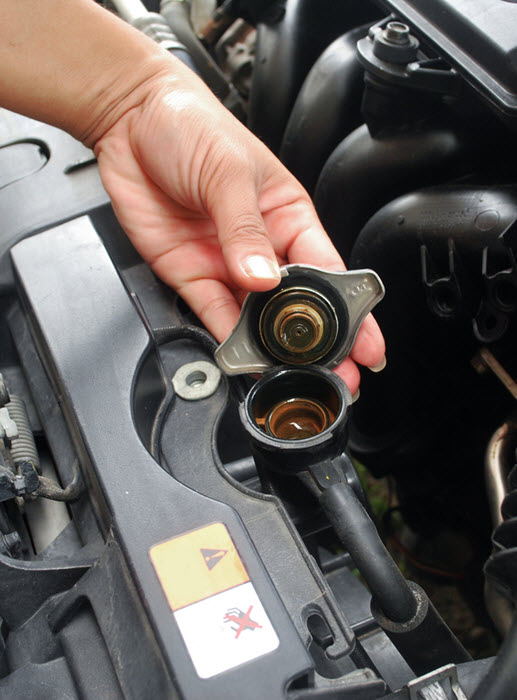
A sealed cooling system does not consume coolant. If the tank is low, it is going out somewhere or into the engine. On European cars it hides in one of four places: the expansion tank seam, the water pump shaft seal, the thermostat housing, and the crimped plastic end tanks on the radiator. Pink or blue crust on a hose neck is dried coolant pointing straight at the joint it came from, and a pressure test finds it. BMW N54 and N55 expansion tanks crack at the same molded seam. Year after year, car after car.
Desert Heat Kills Plastic Cooling Parts Years Early
Glass-filled nylon goes brittle from heat cycling, and this valley cycles it hard. Cars sit on black asphalt at 110°F, run the A/C at every light, then park in a garage that stays warm all night. The polymer loses plasticizer, the fibers pull away from the resin, and the part finally cracks along a molding line under 15 psi of system pressure. So a coolant flange on a Volkswagen or a thermostat housing on a Porsche gives up years earlier here than the same part does on the coast. Age beats mileage.
The Wrong Coolant Turns the System Into a Chemistry Problem
Coolants are not interchangeable. Mixing them is worse than being a quart low. VW and Audi use G12 and G13 lobrid coolant, BMW and Mercedes specify silicate-free HOAT formulas, and Porsche keeps its own approval list. Mix an inorganic green universal coolant into any of them and the additive packages drop out of solution as a brown sludge that scours the water pump seal and plugs the heater core. Universal coolant is marketing. If somebody topped the car off with the wrong jug, the fix is a full drain, flush and refill with 50/50 distilled water and the specified fluid.
Fans and Airflow Faults Show Up While You Are Sitting Still
A car that runs cool at 65 mph and heats up in traffic has an airflow problem, not a coolant problem. At speed, ram air through the condenser and radiator does the work. Stopped, everything depends on the electric fan, its control module and the shroud that forces air through the core. BMW’s pulse-width-modulated fans fail gradually — they still spin, just not to commanded speed — so the gauge only creeps up once ambient temperatures are high enough to expose it. Heat finds it. Check the fan, the control module, the fuse and the coolant temperature sensor before anyone condemns a radiator, and clear the debris packed between the condenser and the core.
What Overheating Costs Once You Keep Driving
Stop the car. An aluminum head on a hot engine warps quickly, and once the head gasket goes you are into a repair that dwarfs the part that caused it. Coolant pushed into a cylinder washes the bore. Oil and coolant mixing turns the dipstick into a milkshake and takes the bearings with it.
A thermostat housing, an expansion tank, a water pump — those are ordinary jobs on an ordinary morning, and driving five more miles is what turns them into engine work. Drivers coming down the grade from Red Rock Canyon toward Summerlin put real sustained load on a cooling system, and that is exactly where a marginal fan or a tired water pump finally shows itself. Towing to the shop is available, and it is cheaper than the alternative.





Luxury Vehicles We Service
AUDI
Bentley

BMW

Ferrari

Land Rover

Maserati

Mercedes Benz

Porsche

Rolls Royce
Volkswagen

Frequently Asked Questions
Why does my BMW overheat in traffic but not on the highway?
That pattern points at the electric fan or its control module. Not the radiator. Moving air cools the core on the freeway; at a stoplight the fan has to do all of it. A fan spinning slower than commanded stays hidden until the ambient temperature climbs far enough to expose the shortfall. Then it shows.
How much coolant loss is normal?
None. A sealed system holds its level for years. If you are adding coolant every few months there is a leak — usually the expansion tank, the water pump seal, a plastic thermostat housing or a radiator end tank — and a pressure test will find it.
Can I put water in my Mercedes coolant tank to get home?
In an emergency, yes, distilled water will get you off the shoulder. It dilutes the corrosion inhibitors. Treat it as a limp-home measure and nothing more. Have the system drained and refilled with the specified coolant, mixed 50/50. Do it soon.
What are the signs a radiator is failing?
Wet crust at the plastic end tanks, a sweet smell after shutdown, brown staining on the fan shroud, coolant on the garage floor, and a temperature gauge that will not sit still. Many European cars trip a low-coolant warning first. You may never see a puddle.
How long can you drive an overheating car?
You should not drive it at all. Once the gauge enters the red an aluminum head can distort in minutes, which is how a thermostat job becomes a head gasket job. Pull over. Shut it off, let it cool, and have it towed instead of driven.
Get the Cooling System Checked Before It Boils
Coolant on the driveway is not something to watch for another week. Paladin Automotive is at 5240 Spring Mountain Road B, Las Vegas, NV 89146, and towing to the shop is available if the car should not be driven. ASE-certified technicians. Factory-level scan tools, OEM and OE-quality cooling parts. Hours are Monday through Friday 7:30 AM to 5:00 PM and Saturday 8:00 AM to 2:00 PM, closed Sunday. Booking is online at paladinautomotivelasvegas.com.
Let's get your vehicle back to peak
performance. Tell us what your car
needs-we'll take care of the rest.
- ASE-Certified European Specialists
- Honest Estimates & Transparent Service